Notes
8 September 2026
Claude had this “Thought” today:
“Her website reads as art not a shop”
On Science and AI
When you ask AI “give me tips for coping with my ADHD backed by science”, the AI (a bot) does not by default have access to the “science” you think. In general bots are blocked from accessing scientific papers. The bot will however have access to “interpretations” of the papers from website that do not block bots, e.g. this one. Unfortunately, increasingly these websites also have been written by AI (because why would someone give AI bots knowledge for free without any reward - page click).
Hyperfocus
As part of a rabbit hole of trying to understand how to make Google say “short obsessions is a website/shop/blog”, rather than quoting r/Healthygamergg when you Google “short obsessions”, I went off on a adventure to learn about “short obsessions”.
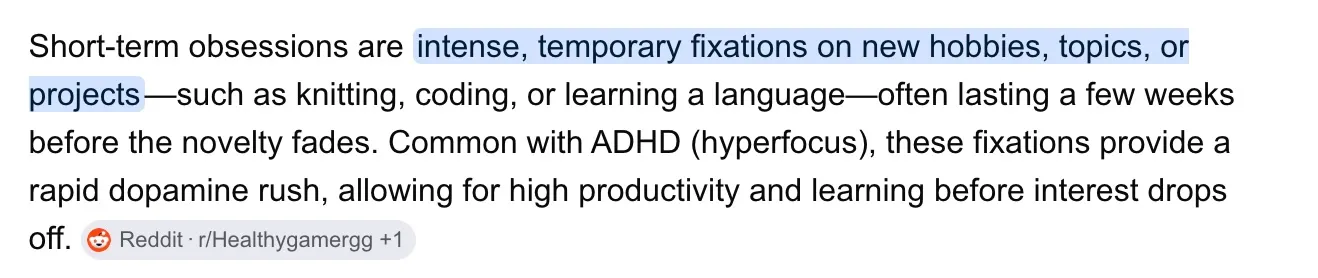
Firstly, the term “short obsessions” is not a scientific one, and it also has little to do with the word “obsession” within OCD. However, the term “hyperfocus” has recently gained traction in the science community. The paper “Hyperfocus: the forgotten frontier of attention”, Ashinoff & Abu-Akel (2021)Ashinoff & Abu-Akel (2021). “Hyperfocus: the forgotten frontier of attention.” Psychological Research 85:1–19. doi.org/10.1007/s00426-019-01245-8 is not only a good starting point but it is also quite readable. Most interestingly it argues that “Hyperfocus” might be the same phenomenon as “Flow""Flow” is Mihály Csíkszentmihályi’s term (1990) for total, effortless absorption in a task. [missing reference] viewed through different lenses.
Hyperfocus, broadly and anecdotally speaking, is a phenomenon that reflects one’s complete absorption in a task, to a point where a person appears to completely ignore or ‘tune out’ everything else.
Let’s compare the criteria for Hyperfocus and Flow side by side:
| Hyperfocus criteria | Corresponding flow criteria / experiences |
|---|---|
| Hyperfocus is characterized by an intense state of concentration/focus | Intense and focused concentration on the present moment |
| When engaged in hyperfocus, unrelated external stimuli do not appear to be consciously perceived; sometimes reported as a diminished perception of the environment | Merging of action and awareness Loss of reflective self-consciousness (i.e., loss of awareness of oneself as a social actor) Distortion of temporal experience (typically a sense that time has passed faster than normal) |
| To engage in hyperfocus, the task has to be fun or interesting | Experience of the activity as intrinsically rewarding, such that often the end goal is just an excuse for the process Perceived challenges, or opportunities for action, that stretch but do not overmatch existing skills |
| During a hyperfocus state, task performance improves | A sense that one can control one’s actions; that is, a sense that one can in principle deal with the situation because one knows how to respond to whatever happens next |
Adapted from Ashinoff & Abu-Akel (2021), “Hyperfocus: the forgotten frontier of attention”, Table 2.Ashinoff & Abu-Akel (2021). “Hyperfocus: the forgotten frontier of attention.” Psychological Research 85:1–19. doi.org/10.1007/s00426-019-01245-8
Personally, I have noticed that I am the most “hyperfocused” when going on one of my “internet adventures”. That is when I search for answers on “how?”, “when?”, etc. Each one of these searches, also ends up making me buy a new books (by the time they arrive however, the “obsession” has moved on to the new thing)